I’m on a writing retreat where a few friends and I are exploring what it means to try to “change the world with words,” especially now, when there are a lot of words circulating but seemingly less and less time for ideas.
See below for info on my upcoming tour with my game Billionaires & Guillotines and information on a London antifascist workshop.As part of that, we’re exploring the affordances and terrors of the horrible, billionaire-run social media empires. My friend Sarah Stein Lubrano (who is a marvellous ninja at all this) took a video of me ranting about the obnoxious gushing over Mark Carney’s speech to the World Economic Forum last week.
I called Carney a warlord. It went kinda viral…
As you can see, it generated… a lot of comments!
Obviously (or not so obviously?) in this reel I’m using a bit of hyperbole for rhetorical effect. But I wanted to elaborate my position a bit, without spending many days writing and citing. So I made a longer video.
The tl;dr
Carney presents himself as the liberal alternative to Trump’s fascism, but also as a straight-shooting realist from a “middle power” who can’t afford the illusions of the erstwhile “international rules-based order.”
But Trump’s fascism is fuelled by resentment towards the neoliberal, financialized, austerity-driven order of which Carney was a key functionary, first during his time as a Goldman Sachs banker, then during his leadership of the Bank of Canada and the Bank of England, and in his affiliation to the World Economic Forum itself.
We should see Carney as a key facilitator of the processes of financialization: not only the increased power and influence of financial firms, but the subordination of governments to their needs and the broader transformation of society towards market rule. It’s true that he was a central banker and so not directly in charge of government policy, and also that he was mildly concerned about austerity in the UK during his tenure. That doesn’t change the fact he was and remains a key player in the establishment and maintenance of the financialized order.
Fascism emerges from and is a reaction to the contradictions and agonies of capitalism and is often supported by key capitalist actors. The system Carney helped build has delivered us a world of cynicism, austerity and political ruination within which fascist sentiment and politics incubated, and to which fascism promises a (false and violent) solution.
Carney’s sober “realism” is not a defence of liberalism, but a defence of what is likely to be a ruthless and unapologetic form of cynical and extractive capitalism, this time without even the fig leaf of a respect for Indigenous rights, ecological protections, workers’ rights, etc.
In the face of all this, we must refuse the “realism” of both Carney and Trump who, like so many of the political warlords on the global stage, tell us the hell they’ve created is all that is or can be. In spite of their loathing for one another, both Trump and Carney present themselves as regretfully doing what must be done.
It’s a class war on the people and a war on our imaginations. We need to rekindle a politics based on the radical collective reclamation of our potential to make the world together by reclaiming the wealth and power stolen from us.
But why a warlord?
This is part of a new project I am working on that uses the idea of the warlord to describe a certain inflection of power within capitalism today.
It’s still in development, but it essentially aims to describe something similar to what others (Yanis Varoufakis, Jody Dean, Cédric Durand) have framed as somehow a return to or revivification of feudalism.
I’m not convinced feudalism is an accurate analytic description of the current political-economic situation or a useful political metaphor. But I think it does try and describe something important about how capital can produce, and is reproduced by, certain kinds of degraded sovereignty.
What I am speaking of as warlordarchy aims to capture that, but move us away from the misleading notion of feudalism while also affording us a better explanation for how both fascist and neoliberal approaches to capitalism converge.
To call Carney a warlord brings him into that alignment, and it also reinforces what I think is the key point. Both domestically within Canada and internationally, Carney’s “values-based realism” is, in fact, class war. In Canada, his agenda will demand state violence to abrogate Indigenous sovereignty and repress labour and environmental movements.
But more than that, Canada has long been a country of economic warlords. Our infamous and imperialist mining and extractive sector, for example, or the small, incestuous networks of families and corporations that dominate the country’s economy.
Stay tuned for more.
Some further reading
On financialization
Blakeley, Grace. Stolen: How to Save the World from Financialisation. Repeater, 2019.
Haiven, Max. Cultures of Financialization: Fictitious Capital in Popular Culture and Everyday Life. Palgrave Macmillan, 2014.
Mader, Philip, Daniel Mertens, and Natasha van der Zwan, eds. The Routledge International Handbook of Financialization. Routledge, 2019.
On the World Economic Forum and the global capitalist class (not conspiracism)
Klein, Naomi. “The Great Reset Conspiracy Smoothie.” The Intercept, December 8, 2020. .
Robinson, William I. “Debate on the New Global Capitalism: Transnational Capitalist Class, Transnational State Apparatuses, and Global Crisis.” International Critical Thought 7, no. 2 (2017): 171–89.
On Carney
Clarke, John. “Mark Carney’s Class War.” Canadian Dimension, June 17, 2025..
Henaway, Mostafa. “Crisis as Class Strategy.” Midnight Sun, January 23, 2026.
Moscrop, David. “Mark Carney Wants You to Believe in the Free Market” The Breach, August 12, 2021.
Also, for a recent summary of the various ways Canada has colluded and continues (under Carney) to collude with American imperialism, including by repressing Canadians, you can read my mother, Judy Haiven’s Substack on the topic.
On the ideology and political economy of central bankers and monetary policy
Lapavitsas, Costas. Profiting Without Producing: How Finance Exploits Us All. Verso, 2013.
Panich, Leo, and Sam Gindin. The Making of Global Capitalism: The Political Economy of the American Empire. Verso, 2012.
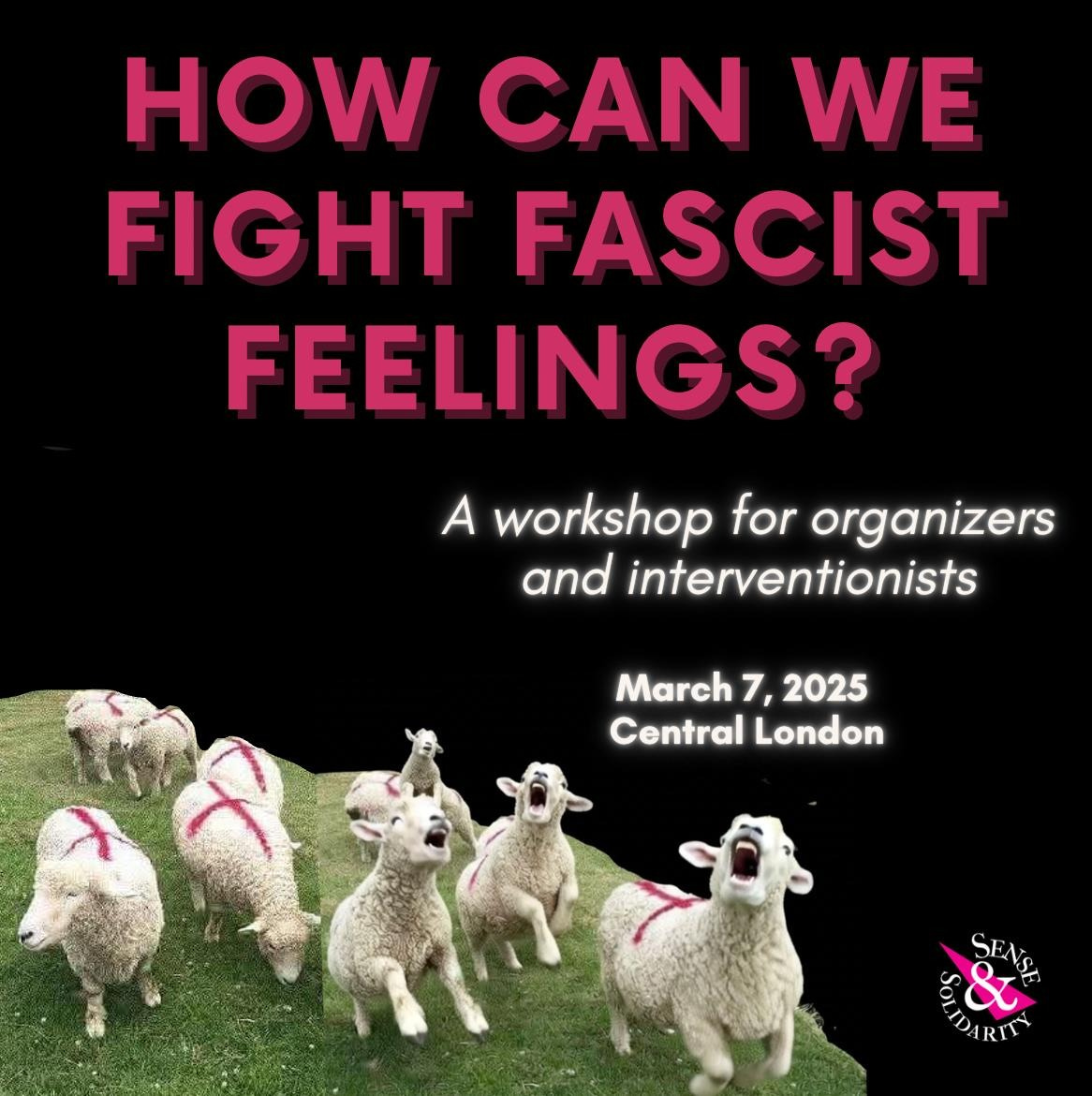
How can we fight fascist feelings?
As Sense & Solidarity, Sarah Stein Lubrano and I are hosting a 1-day workshop in London on March 7 “How can we fight fascist feelings?” Registration is open now.
Fascism is on our doorstep. How has it seduced the hearts and minds of millions of people? What can break the spell?
In this one-day workshop (10am-6pm) we will explore:
How can we identify and name fascism in our times? How does it feed on racist imperialism and capitalist misery?
How does reactionary ideology work and what changes minds? Whose mind is worth changing?
How do we contend with poisoned legacy and social media ecosystems? Who should we be speaking to and how?
How do we strategize and not just react? How can cultural work support material struggles?
This workshop is for people involved in social movements or doing interventionist cultural work (writing, content-creation, research). Though vitally important, we will not be talking about antifascist street tactics or community organizing, but rather on the struggle on the terrain of ideas, images, feelings and fears. Our focus is on theoretical and practical questions of communication, imagination and the social mind.

Billionaires & Guillotines on tour!
I’ll be on tour in February and March with my new board game Billionaires & Guillotines, which is available for preorder over at the Pluto’s website. The following dates have been confirmed. On the game’s website you can find a calendar with details.
February 8 - Frankfurt
February 9 - Cologne
February 10 - Amsterdam
February 11-14 - Brussels
February 17-19 - Bulgaria
February 22-25 - Berlin
February 27 - London
February 28-March 2 - Utrecht
March 5-6 - Brighton
March 8-10 - London
March 11 - Manchester
March 12 - Leeds
March 13 - Durham
March 16-17 - Glasgow
March 18-21 - Copenhagen
March 26 - Exeter
March 27 - Bristol
And why not treat yourself to some Billionaires & Guillotines merch? It’s all ethically and ecologically produced, etc.